


Mount a standard single closet rod about 66 to 68 inches above the finished floor, measured to the rod centerline. If you’re planning a double-hang section, use roughly 80 to 84 inches on top and 40 to 42 inches on the bottom, and keep the rod about 12 inches out from the back wall. Accessibility needs and kids’ closets call for lower placement, which we cover below.
TL;DR:
- Mount a single closet rod at 66 to 68 inches from the floor, measured to the centerline, to accommodate most adult clothing without dragging.
- For double-hang systems, place the upper rod at 80 to 84 inches and the lower at 40 to 42 inches, ensuring roughly 36 to 40 inches of vertical space per tier.
- Maintain a 12-inch depth from the wall and at least 2 inches of clearance between the rod and shelf to prevent garment wrinkling and hanger jamming.
- Children’s closet rods should be installed at 30 to 36 inches for ages 3 to 6, and 40 to 48 inches for ages 7 to 12, with adjustable hardware to grow with the child.
- When designing a closet, measure for your specific garment lengths, consider ceiling height and wall irregularities, and consider professional installation for complex or non-standard spaces.
Table of Contents
- Standard single-rod height and design rationale
- Double-hang systems and children’s rod heights
- Rod depth, shelf clearance, and spacing to protect clothing
- How to measure and mount a closet rod
- Choosing rod heights by garment type and closet layout
- Pro tips and common mistakes to avoid
- How professionals apply these standards: Classy Closets’ approach
- Author’s quick take and recommendation
- Get a custom closet built around your wardrobe
- FAQ
- Sources
Standard single-rod height and design rationale
The 66 to 68 inch range exists because it works for most adult clothing without dragging shirts or pants on the floor. Shirts and blouses typically run 36 to 40 inches long when hung, so a rod at 66 to 68 inches leaves clean floor clearance for nearly everyone’s wardrobe.

There’s a difference between measuring to the rod’s centerline and measuring to its bottom edge, and it matters more than people think. Centerline measurement is the industry standard because it accounts for the rod’s diameter and gives a consistent reference point regardless of bracket style. If you measure to the bottom of the rod instead, your garments will hang about an inch lower than planned.
Choosing between 66 and 68 inches usually comes down to ceiling height and who uses the closet. Taller households or rooms with 9-foot ceilings often lean toward 68 inches, while standard 8-foot closets tend to use 66.
Long garments change the math entirely:
- Shirts and blouses: about 36 to 40 inches of hanging length
- Long dresses and coats: 60 to 78 inches, which usually needs a dedicated long-hang zone at 72 to 78 inches
- Walk-in closets: can mix a single tall rod on one wall with double-hang zones elsewhere
Double-hang systems and children’s rod heights
Double-hang setups double your hanging capacity by stacking two rods instead of one. The common configuration places the upper rod at 80 to 84 inches and the lower rod at 40 to 42 inches, with some field guides citing exact figures like 81.75 inches on top and 40.5 inches on the bottom. Each tier gives you roughly 36 to 40 inches of vertical hanging space, enough for folded shirts, skirts, and short jackets.
- Measure your tallest folded garment for the lower section before locking in the 40 to 42 inch height.
- Set the upper rod at 80 to 84 inches, leaving headroom below the shelf or ceiling.
- For kids’ closets, drop the rod to 30 to 36 inches for ages 3 to 6, or 40 to 48 inches for ages 7 to 12.
- Install adjustable or dual-track hardware if you want the rod to grow with your child instead of replacing it every few years.
The trade-off with double-hang is obvious: you gain storage capacity but lose the option for long dresses or coats in that section, so most closets benefit from reserving at least one zone as a single tall rod.
Rod depth, shelf clearance, and spacing to protect clothing
Rod depth, or how far the rod sits from the back wall, matters as much as height. A 12-inch setback gives standard hangers enough room to hang freely without pressing suits and jackets against the wall, which flattens shoulders and creates wrinkles over time.
Shelf clearance is the other half of the equation. A minimum of 2 inches of vertical clearance between the top of the rod and the bottom of the shelf above lets hanger hooks slide on and off without catching.
- Less than 12 inches of depth: shoulders get squeezed and garments rub the wall
- Less than 2 inches of shelf clearance: hangers jam, and you end up yanking clothes instead of lifting them
- Both measurements correct: clothes hang straight and come off the rod without a fight
How to measure and mount a closet rod
Before drilling anything, gather a tape measure, a level, a stud finder, a drill, wall anchors, rod brackets, and the rod itself.
- Measure 12 inches out from the back wall to mark your rod’s depth.
- Mark the height on both ends of the closet, using centerline measurement for consistency.
- Run a stud finder across the wall to locate framing wherever possible.
- Set bracket positions at the marked height and depth, then check both brackets with a level before drilling.
- Mount the brackets and rod, then hang a loaded set of clothes to test for sag.
Pro Tip: Measure twice on both sides of the closet, since older homes often have walls that aren’t perfectly square, and a rod that’s level on one end can be off by half an inch on the other.
Account for shelf thickness when marking your height. If you’re working around a sloped or angled ceiling, step the rod down in sections rather than tilting it. For heavy loads, like a fully packed coat rod, stud-mounted brackets hold up far better than anchors alone. If you’re not confident about load limits or wall type, calling a professional installer saves you from a rod crashing down mid-season.

Choosing rod heights by garment type and closet layout
Matching rod height to what you actually own makes a closet functional instead of just organized-looking. Shirts and blouses need about 36 to 40 inches, folded pants or skirts fall in the 36 to 42 inch range, and long dresses or coats need 60 to 78 inches of clearance.
- Reach-in closets: prioritize a double-hang setup at 40/80 inches if you only own a few long garments
- Walk-in closets: dedicate one wall to long-hang at 70 to 78 inches and use double-hang on the remaining walls
- Shoe and drawer space: plan these below or beside rods so you’re not fighting for floor clearance
The goal is matching your actual wardrobe to the layout rather than defaulting to one rod height for the entire closet.
Pro tips and common mistakes to avoid
Set your rod depth first at 12 inches, then choose height based on what you’re hanging. Getting depth wrong early forces you to redo brackets later.
- Measuring to the top of the rod instead of the centerline throws off your height by close to an inch, which adds up across a full closet
- Ignoring shelf thickness or decorative trim means your “66 inch” mark might land somewhere else entirely
- Low ceilings call for staggered zones, pull-down rods, or a separate pant rack instead of cramming a double-hang system where it won’t fit
Pro Tip: Dry-fit your brackets and temporarily hang the rod before committing to final screws. It takes ten minutes and saves you from patching extra holes later.
How professionals apply these standards: Classy Closets’ approach
Standard measurements are a starting point, not a finished plan. When we design a custom closet, we start with those industry numbers, then adjust for your actual garment mix, your reach, and the quirks of your specific closet, whether that’s an uneven wall or an oddly placed window.
Every project includes a free in-home 3D design consultation, itemized pricing so you know costs before work starts, and installation handled by our crew rather than subcontractors. We back every job with a workmanship warranty. For complex layouts, heavy-load sections, or walls that aren’t square, a professional eye catches problems a tape measure alone won’t.
Author’s quick take and recommendation
Stick with 66 to 68 inches for a single rod and 40/80 for double-hang. Those numbers work for most closets. But if your wardrobe leans heavy on long coats, your walls aren’t square, or you just want it done right the first time, that’s when calling a professional installer beats a second trip to the hardware store.
— Gary Pavitt
Get a custom closet built around your wardrobe
Standard rod heights work until your closet has an angled ceiling, a mix of long coats and short jackets, or a wall that isn’t quite plumb. That’s when a custom closet design pays off: we measure your space in 3D, price everything up front, and install it ourselves with a 10-year workmanship warranty behind the work.
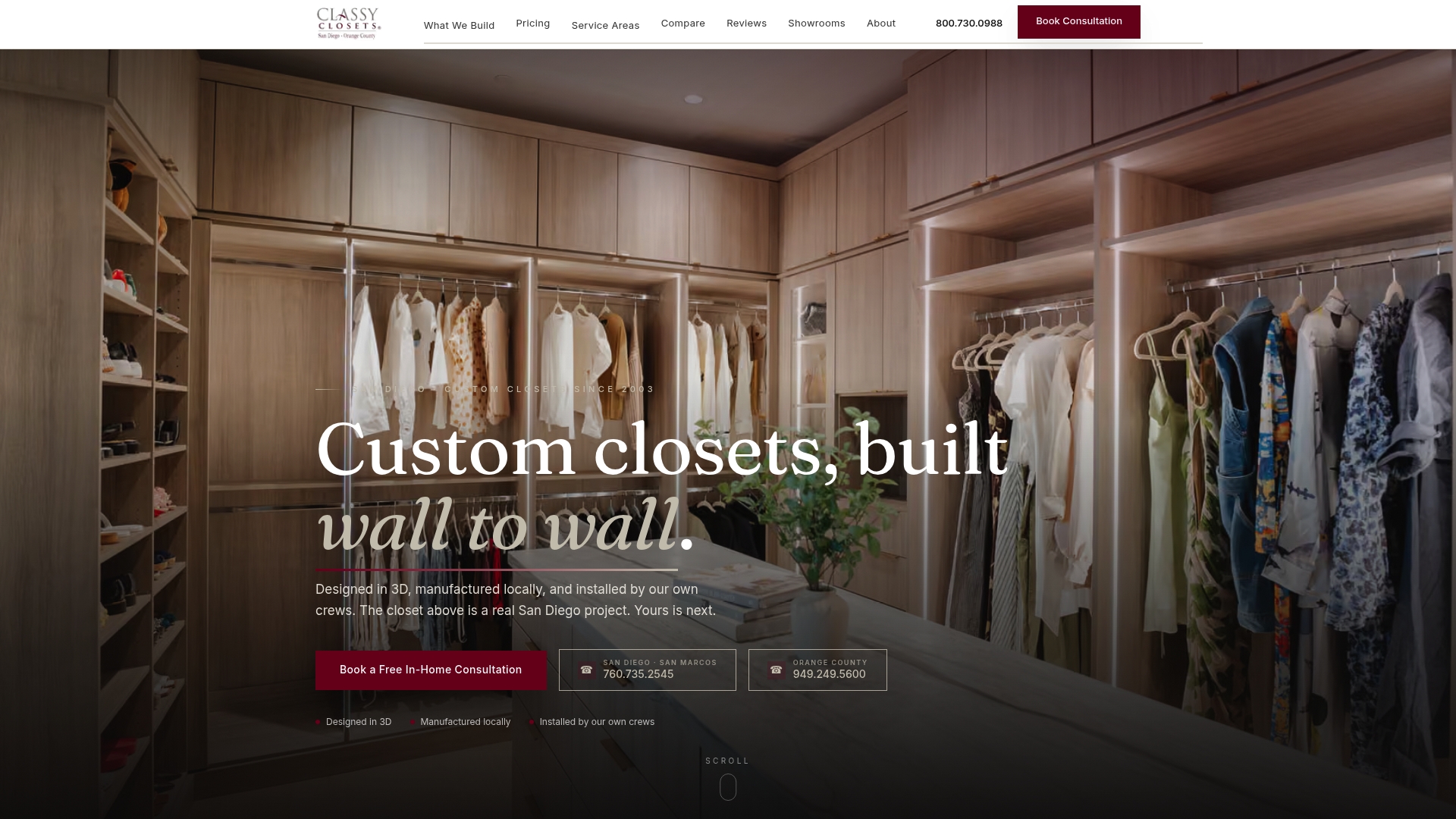
If you’re ready to stop guessing at bracket placement, request a free design consultation and we’ll build the layout around what you actually own.
FAQ
What is the proper height for a closet rod?
A single closet rod is typically mounted 66 to 68 inches above the finished floor, measured to the rod’s centerline. This height fits most shirts, pants, and jackets without touching the ground.
How far apart should double hang rods be?
Double-hang systems commonly place the upper rod at 80 to 84 inches and the lower rod at 40 to 42 inches, giving each tier about 36 to 40 inches of hanging space. This spacing works for shirts, folded pants, and skirts, but not for long dresses or coats.
How far should a closet rod sit from the back wall?
A rod depth of about 12 inches from the back wall is standard, since it gives hangers enough clearance so garments don’t press against the wall. Less depth tends to flatten shoulders and cause wrinkling over time.
What closet rod height works for kids?
Children’s closet rods generally range from 30 to 36 inches for ages 3 to 6 and 40 to 48 inches for ages 7 to 12. Adjustable or dual-track hardware lets the rod move up as your child grows instead of needing replacement.
Does ADA have specific reach requirements for closets?
Yes, for accessible installations, ADA guidance under Fig. 38(b) sets a maximum high side reach of 48 inches when reaching over an obstruction up to 10 inches deep. Standard residential closets aren’t required to meet this, but it’s the reference point for accessible designs.
Sources
- Here’s the Right Shelf and Closet Rod Height - Taskrabbit Blog
- Solved! This Is the Perfect Height for a Closet Rod - Bob Vila
- Fig. 38(b) Closets (ADA guidance)


